


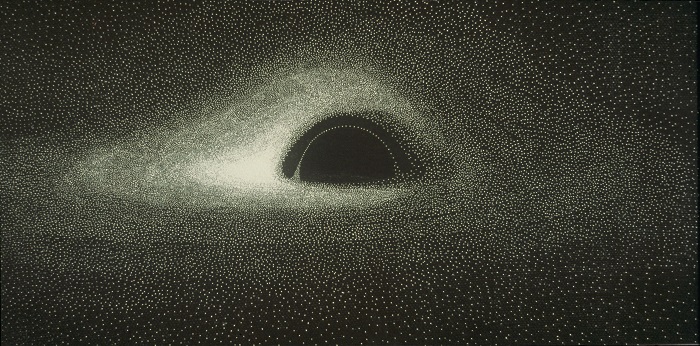
A Black Hole: What Is It?
Deep in the vastness of space, there are countless objects, whether living or long dead. Whether it has a total mass of 1,000,000 suns or the mass of a grain of sand, there can be theoretically, anything. In the Year 1964 ¨Cygnus X-1¨ Was discovered as the first ¨Black Hole¨ found, as being identified through x-ray detectors. But with it being discovered, there was a humongous question for most who heard of it: What is a black hole? As well as how did we know that it was one?
Albert Einstein, a scientist who discovered a lot for the astronomical world about our universe, proposed his theory of relativity. His famous theory of relativity was a world-changing idea that changed everything about what’s beyond. While the ideas last into the present day, the theory originally brought the concepts of Black Holes into view, but only as a theory. He predicted them as a possibility, yet with no confirmation, while he was a skeptic himself, believing they were unable to form due to the physical limitations, becoming a mystery itself. The theory stated that black holes were points in the universe where objects have an incredible amount of mass that bends space and time.
A black hole has 3 main Parts. First, the farthest from inside is an Accretion Disk. This is the area outside where all gas, dust, and stars spin around it. The Event Horizon is the point of no return, nothing, not even light can escape, also known as the boundary of the black hole. Before the event horizon, you experience the theoretical idea of spaghettification, which is where tidal forces of a black hole stretch and pull you and shred things into a supposed spaghetti noodle. Past that point lies The Singularity. This is where gravity is most strong, while the density gets so high that it is currently described as closest to infinity, where anything and everything beyond that is unknown. It’s theorized that as you fall deeper and deeper, you experience time as normal, but on the outside it stretches over hundreds of millions to billions of years to pass, which is called ¨Time Dilation¨.
In the famous and well-known movie ¨Interstellar¨ we are given a scientific description and example of this. (spoilers ahead) In the movie, Cooper’s crew uses the black hole ¨Gargantua¨ mass and gravity to slingshot the main characters to where they need to go. During this stunt, it costs the crew 51 years, which to them felt as if only 20 minutes on earth. So, with that being said, I wanted to get any information from someone who has a specialty in this field, so I interviewed Mr. Stedman. I asked the questions, what he would like to know about the object, how it’s formed/created, as well as if he has a personal theory for what happens beyond the event horizon.
Your question for the object: ¨If everything’s getting pulled to the singularity, what happens there? We have 0 scientific evidence. Does all the matter get shot out of a White Hole?¨
How is a black hole formed/created: ¨It’s created by a supermassive star, so it’s really a star, it’s got so much mass, and so much gravity not even light can escape. It’s not a hole, it’s spherical like a star. In order to form, you need a lot of matter and dust. Stellar black holes are smaller as a county but with a mass with 3 suns, so smaller rogue objects.¨
Idea of what happens past the event horizon, do you agree with what’s scientifically considered: ¨It depends if you’re in a supermassive black hole, it’s so big that while people think it’s black, you see all colors around you, and you can still live, beyond singularity you’ll get spaghettified. Smaller ones, you’ll get spaghettified instantly.¨